Monday, August 1, 2011

Lake Titicaca


I spent the day at Machu Picchu (awesome) and then headed back to Cusco the same day. I spent the night there and headed to Puno, on Lake Titicaca. I made it from Iquitos in the north of Peru, to Puno far south on the border of Bolivia in 4 days. Phew!!!

This is the Uros Island on Lake Titicaca. The Uros were once a very peaceful people who moved to self-made floating islands on the lake, escaping warfare between Incas and other groups. This pre-Inca people survived by trading or selling fish, but nowadays the resources aren’t enough for them to sell any. The over-harvested lake is now only able to supply enough fish for local consumption; therefore the Uros rely entirely on tourism to subsist.


It is a bit ironic to see how this culture has been mainly preserved due to tourism, yettheir way of life and environment has been greatly affected by it. Without tourists they would have a really hard time surviving and would have, most likely, had to move and adapt to life on land; but they’ve kept their traditional clothing and maintained the floating islands (which need to be up kept constantly) in order to make a profit, which has helped preserve these culture. They went from being a fishing community to one whose life now revolves around getting money from tourists. If you visit and don’t buy any of the overpriced handcrafts, you will no longer be as welcomed. Many of the visitors I met during the tour told me they felt very guilty and forced to buy things.

The Uros can’t be blamed though. They were once a people that lived peacefully on the lake with an uncomplicated way of life, and throughout the years they’ve had to adapt to a capitalists society and the tourism that flooded the lake. These were concepts unknown to them and now they do as they must in order to continue living on the lake – a sacred place for the Incas.

The Uros speak Quechua, Aymara and Spanish. The islands they live on are made of layers of totora reeds – a very prolific plant that grows there – laid over floating soil that they cut and tie together. Totora reeds are very important for the Uros. Besides using them for the islands, it is also eaten and used to make boats and houses.

An example of how this community has changed their way of life in order to cater to tourists and profit is their “Mercedes Benz” vessel designed exclusively to take tourists for a ride at a varying price. This vessel doesn’t even have a Quechua, Aymara or Spanish name; it is simply called the “Mercedes Benz.”

Despite the uncomfortable reality of these people, it is for sure a place to visit. It is absolutely beautiful and relaxing, although a bit expensive and of course, although they depend on tourism, the many boats on lake Titicaca are not helping the declining ecosystem.


Saturday, July 30, 2011

Machu Picchu


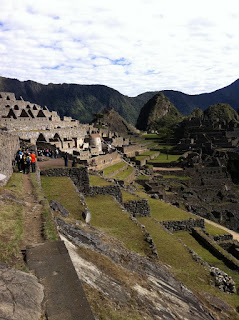
I hiked up the steep trail to Machu Picchu early in the morning. The sun was just starting to rise and the day to warm up. Cusco is pretty high in altitude and cold, Machu Picchu is lower and it has a subtropical warm weather, so it takes a minute to adjust to the sudden change.

As I advanced the sun rose as if synchronized with my ascent. The weather was perfect, the view of the mountains around me was magnificent and the energy of this magical place overpowered my tiredness.

Surprisingly I was on of two people hiking up at this time. The hundreds of tourists that were also going to Machu Picchu that morning were taking the bus service. This is really ironic because Machu Picchu is located on an amazing natural place that needs to be protected if we want it around and beautiful for the years to come, yet most pollution comes from these buses than make constant runs, up and down during the day, so people can enjoy it more comfortably.

This is just one of they ways in which Machu Picchu is being greatly affected by the hundreds of thousands of tourists that visit every year. Due to the negative effect of tourism, the Peruvian government is considering either closing it or limiting the entrance in the near future in order to preserve it, said one of the guides at the site.

It was very rewarding to walk up for an hour and a half and suddenly find this amazing place hidden within the mountains. It was actually the best reward anyone could ask for. It makes the experience much more interesting, almost like a pilgrimage to one of the most amazing places in the world. So, in my opinion, is much more worth it to walk up and earn the right to indulge in such beauty, than being bused up and down like a good tourist and bad citizen of the world.


The ascent


The Inca city shows up


Beautiful

The genius of the Incas. Amazing architecture
Breathtaking


So lucky to be here!


It was a really good day :)

Beauty of Peru

The changing scenery of Peru is just absolutely fantastic. We went from desert to snow peaks overnight. I woke up on the bus to a stunning sunrise over The Andes as we approached Cusco.


Going Going Going and Cusco

The alarm went off at the crack of dawn once again, as it has done several times during this trip. I awoke and decided to skip the cold shower and instead sit outside to watch the sunrise to the sound of the roosters’ crow. It was time to leave Iquitos and although the experience hadn’t been exactly what I had imagine it would be, it was still an experience – a very interesting one – in fact, so I wanted to take a moment and take it all in. I wanted to breathe the jungle air once again, deeply and aware.

I walked to the airport because Juan lives really close. The sun had risen and I soon regretted skipping that shower.

After a delayed flight and a foodless morning I was back in Lima. I got off the plane and immediately had to find my way to the bus terminal. The tranquility of the jungle seemed already far behind. I was running to catch a bus to Cusco and it was a marathon from there on.

After 22 hours on a bus I arrived at Cusco().

Because of the celebration of the 100 years of discovery of Machu Picchu there were tourists and music at every corner. I could feel celebration all around.

I was in dire need of a shower, so before anything else I found a hostel with a “hot” shower. Although I learned, way in the beginning of my trip, that an actual hot shower is a luxury difficult to find for $10 a night.

Regardless, after the very needed shower I went out and walked around the city. The colonial architecture, the many churches and plazas and the booming commerce (mainly catering to tourists) make of this city a really vibrant one.


I walked around for most of the day along cobbled streets until there was nothing new to see. Cusco could easily lure me into its party atmosphere and it would have taken me a while to move on, so on a whim I purchased a train ticket and headed to Aguas Calientes, the nearest town to Machu Picchu, that same night. I picked up my pack and I was back on the road.

I arrived in Aguas Calientes around midnight. I caught up with some Korean friends I had met previously and we chatted for a few hours (hostelling is a very social activity). I slept for maybe three hours and awoke at four, before sunrise, to stand in line and get tickets for Machu Picchu. At around six o’clock I was on my way to the ancient Inca city, hiking alone up the steep trail as the sun started to show from behind the mountains.

Monday, July 25, 2011

Belen Market


The most fun I had in Iquitos was at the Belen market. Belen is the poorest district in Iquitos and they call it “the Venice of the Amazon” because it floods every rainy season, leaving its streets underwater from February to April.

The market extends for many blocks and it feels like a maze as you walk through it during the hectic business day. Wherever you look there are women behind their stands, usually with a flyswatter at hand, keeping the flies away and cutting up chickens, fish and some times grilling caiman meat, which they call “lizard meat.” Yumm!

The food sits on wooden tables over a plastic tarp. There are many kinds of spices of all scents and colors that combine with the smell of the meat sitting under the sun all day. There are a lot of different fruits that are grown locally and potatoes and other produce that are brought by boat from the nearest accessible town-- Pucallpa, some five hours away.

Iquitos can only be reached by boat or plane.


The market also has an herb and remedy section. There it is possible to find the cure to any ailment or ingredients for any potion; Iquitos has a long and dominating tradition of magicians, witches and rituals, Juan Tangoa told me.


Belen is an interesting place where houses are built on stilts or over big logs of wood in order to make them float as the water level rises over five feet every year.

Unfortunately it is also the dirtiest part of the city and all the trash produced in the market gets carried away with the current.

The people were friendly and smiling as they worked. It was the perfect place to get a sense of Iquitos every day life, as they know it.


But it is not all bad


Being in Iquitos has had its positive aspects as well; I have to admit. Meeting Juan, the healer, has been an interesting experience. His life story is amazing, almost unbelievable, in the full sense of the word. He enjoys sharing his crazy experiences and I enjoy listening, although I am never sure were to draw the line between reality and fantasy. I think even he no longer knows, or, perhaps, the fantasy in his life is just as real as anything else.

He was living in the U.S at the time of the Vietnam War and volunteered. He said he was later left behind, along with other South Americans, when the troops pulled out. So they had to fend for themselves and see and do horrible things in order to survive. Therefore he has been lost in insanity (like many others who fought that war) and back, thanks to Ayahuasca. He’s healed himself and many others, who travel from all over the world to Iquitos to have access to his knowledge of medicinal plants and be healed by him and Ayahuasca, “the mother plant,” he said.

He’s fought crocodiles and demons, he says. He’s traveled the world, and explored the depths of the jungle. According to him he’s been killed by a snake and then came back to life. He’s traveled light years to far away stars and also back in time to see it all start. He is, for sure, and interesting man. His name is Juan Tangoa. He is over 60 years old and in perfect shape. He says is the Ayahuasca that keeps him healthy, strong and powerful.

He’s told me many stories, some very nice, all of them amazing and a few kind of hard to believe. All I know with certainty is that he’s been through a lot in his lifetime and he’s a gathered a lot of knowledge. He truly understands the power of nature and knows how to use it.

Out of the many things he told me two really got to me and I hope to never forget.

He told me people are afraid of death when they have not lived life fully, and that the world becomes the size of an orange in the palm of your hand when you have an open mind.

He reminded me that all we have to do in life is live. Because once our time is up, it’s up and there are no second chances. He reminded me that a closed mind will take us nowhere, because it becomes impossible to see the way.

So let’s find what makes us smile. Let’s find what makes us happy; what makes us vibrate from the inside out, what we’re passionate about. Let’s focus less on the negative, on what we lack or what we think is expected from us, yet it brings us down, because in the end, nothing else will matter.

Let’s live life, day by day. Just live. Despite life’s difficulties, there is always beauty around us -- we simply forget. Let’s remember that we are lucky to be alive, to have the opportunity to be in this world in these bodies that feel and dream and hope. Let’s be.

Thank you Juan.

The not so lovely Amazon

Iquitos, Peru.

I left Lima totally excited for the next stage of my adventure. I was hoping to take a break from the polluted cities of South America and immerse myself in the greatness of the jungle, to be amidst exotic animals and learning about medicinal plants, meeting indigenous people and learning from them the way to spirituality in communion with nature.

In other words: the pinnacle of my trip. The reason why I got inspired to travel in the first place; in order to explore indigenous history, in order to reconnect with my roots and, most importantly, Pachamama (mother earth).

Well, as we all know, and sometimes fail to remember, things don’t always go as we hoped. And I have been reminded of it the hard way.

I arrived in Iquitos, the biggest city in the Peruvian part of the Amazon, and shortly after my landing, excitement was being replaced with and urge to cry. I had sort of arranged a four-day jungle expedition with a medicine man where I would learn about the healing powers of plants and participate in an ayahuasca ceremony, which was to be an intensely spiritual experience.

Since communication had been through a third person – not directly with the healer – none of this was going to happen, but I was just about to find out.

I finally met Juan, the healer, at his house and found out he had absolutely no intention of going into the jungle at this time.

Instead of a hut surrounded by nature, the ceremony would take place in a living room surrounded by plastic chairs. The view of the jungle had been replaced by possibly the dirtiest place in the whole Amazon: Iquitos --, the knowledge about medicinal plants only available for those who go on the expedition or stay long-term to study. The price: twice as much as budgeted.

I cannot explain myself enough to convey the sadness I felt. I was stuck in Iquitos and not very happy about it.

It is safe to say that Iquitos is disgusting. The motto of this place: “The heart of the jungle,” their custom: to throw trash on the streets, and far worse, the river. The concept of a trashcan, honestly, doesn’t exist; let alone recycling or reducing plastic consumption. How could this be possible? I asked myself. How could there be so much knowledge about the importance of being environmentally friendly, yet in the heart and lungs of our planet people seem to have no clue? Or simply don’t care? Are we all really that disconnected? My idealized perspective was greatly affected. Every step I took among the trash and every time I saw people carelessly littering my heart ached.

As if that alone wasn’t bad enough, in order to satisfy the needs of tourists, in Iquitos they offer tours where you can supposedly experience the local fauna and indigenous traditions. For a varying amount (depending on how much they want to charge you and how easily you let them) you will visit an island nearby where you can see some caged animals and then continue on to a place on the shore where you’ll be greeted by a “tribe.” Which in reality is a group of topless, indigenous-looking people -- who have converted to evangelicalism – and perform their ancestors’ dances in honor of the anaconda and other sacred animals, now solely for profit.

(you can tell how excited I am to be there)--->

What a joke! My heart ached some more as I realized this is the fait of the amazingly rich native cultures in South America. That’s what we’ve helped them become, a mundane tourist attraction. That is how native communities fit in the “civilized” world. Sad. Because they were once a community that lived in their own autochthonous way, in balance with nature, having rites and music and culture and society and way of life and traditions that they’ve been forced to forget.

There are still around 200 indigenous groups in the Amazon, some of which are moving deeper into the jungle as “the white man,” as Kelvin my guide explained, gets closer to where they live. So although this particular experience doesn’t reflect all the indigenous groups at the moment, it for sure foreshadows what their end will be like. As the need for cattle, timber and economic growth continues to increase in the “developing countries” there will be less space in the jungle for these communities -- once again, they will find themselves forced to change their way of life in order to survive. And that is not the worse part, because the biological loss is far greater than the cultural. The Save The Amazon Coalition, a non-profit organization, points out how we are losing earth’s greatest biological treasures:

“Rain forests once covered 14% of the earth's land surface, now they cover a mere 6% and experts estimate that the last remaining rainforest could be consumed in less than 40 years"

They claim that one and a half acres of rainforest is lost every second.

“Experts estimate we are losing 137 plant, animal, insect species every single day due to deforestation. That equates to 50,00 species a year. As the rainforest species disappear, so do many possible cures for life-threatening diseases. Currently, 121 prescriptions drugs sold worldwide come from plant-derived sources. While 25% of Western pharmaceuticals are derived from rainforest ingredients, less than 1% of these tropical trees and plants have been tested by scientists."

Deforestation done by corporations and governments, added to the locals' littering due to lack of environmental awareness are slowly but surely destroying what is left of the Amazon. It might seem, from the comfort of our air-conditioned rooms that this doesn't affect us, because it's happening far away and is too complex to be resolved. But! Without the rainforest we can say goodbye to clean air, medicine, amazing and sometimes unseen fauna and flora, unimaginable knowledge, and at some point, our own existence.

The "green" rhetoric of our time claims that we are destroying the planet in hopes that you'll buy a more expensive "environmentally friendlier" car (which really makes no no difference). But the reality is, the planet has survived much worse; It has been a ball of heat and then covered in ice; it has been struck by meteors and seen species come and go. It has existed for millions of years; chances are it will still after we --the parasites of this ecosystem-- are gone.

So it is not the planet we are destroying, this is self-destruction at its best.

“Progress” and tourism have left a scar in the heart of the Amazon. This experience scarred me. There was no spiritual epiphany, no contact with my idealized indigenous people, no immersion in nature – just the harsh reality of our time.