Thursday, July 21, 2011

Peru


Peruvian culture is very rich because of European and Inca influence, but also because the land itself, like the rest of South America, is varied, beautiful and rich in natural resources, climates and sceneries. In the north there is the Amazon jungle, with a hot and humid climate, rich in fauna and flora. In the center there is Lima on the edge of a desert. And in the south – within the Andes – beautiful colonial cities like Cusco, contrast with the amazing view of the Inca city of Machu Picchu.

In Cusco the temperature is on the other end of the spectrum regarding the Amazon in the north.

Just like the Inca Empire, the amazingly rich Peruvian culture stretches along the country, varying but remaining a whole, making of this country a beautiful one to explore and a little complex to fully understand. The multifaceted society, its turbulent colonial history and its recent economic development seem a whole mess on the surface, but when you take a deeper look, it is possible to appreciate the awesomeness of this country.

In Peru I fell further in love with this beautiful continent.


Peru, just like much of Latin America, presents a very interesting merger of cultures and traditions. It appears as if the Spanish were able to convert the natives to Christianity only on the surface. But beneath, their Inca traditions still prevail and shine through still to this day.

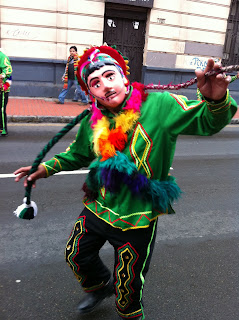
While I was in Lima it was the celebration of Corpus Christi, a catholic tradition. But just behind the image of the virgin that was being paraded around downtown, there were groups of dancers showcasing the traditional Inca dances, celebrating the Pachamama (mother earth) as much as they celebrated Jesus Christ and virgin Mary.

Here there are plenty of churches and Catholic celebrations. But this year Peruvians are also celebrating the 100 years of discovery of Machu Picchu by Hiram Bingham of Yale University, so it was an ideal time to observe the two main influences in Peruvian culture: Spanish and Inca.


Sidewalk Art


Mendo and Alex Cerdan have been going to Barranco to create a different piece of art every week since 2008. Their materials: chalk, the sidewalk, a shared passion for art and the need to make a living.

As one of them draws, the other collects money from pedestrians who are usually very pleased with this type of art exhibit. This is the magic of Barranco; art filters into everyday life, making of this neighborhood “a living poem” as Alex puts it.


There is a merger between the chaos of the street – characteristic of Latin American cities -- and beautiful views of generally ephemeral art.


A drawing takes two to three hours to complete, “depending on the type of sidewalk and the complexity of the drawing,” said Kevin. They call it “fleeting art” because after a few days of being stepped on, is gone.

Lima - Barranco


Lima doesn’t have such good reputation among travelers. It is viewed more as a pit stop than a destination. I was advised by a few not to spend more than a day there. Its almost constant gray skies, its apparent lack of that “special something” and its dusty streets keep the world ramblers at bay. I am not sure if fortunately or unfortunately. I do know though, that I was lucky to peel some layers off this apparently not-so-beautiful city and fell in love with it, particularly Barranco, the art district.

I have come to the conclusion that travelers don’t really enjoy Lima because it is hard to figure out. The city is huge and has lots of traffic, which makes exploration a bit tedious. Most travelers stay in hostels in Miraflores, one of the richest and newest neighborhoods in Lima, home to Larcomar, the fanciest shopping mall, and the pride of Lima’s upper class. If you pick up a guidebook or ask someone in Miraflores to point you in the right direction to a must-see in Lima, they’ll suggest Larcomar, maybe because it is the representation of progress and capitalism in Lima or maybe because it has great view of the shore, I am not sure.

There, you can find Starbucks Coffee, T.G.I Friday’s, Chili’s, or purchase The North Face. It seems to be an icon of progress, as if they were one step further away from being a “third world country.” But what locals might not realize is that only one strange type of tourist looks for this type of environment when traveling. The rest of us want to get the real thing, whatever’s typical, and most autochthonous.

For a more real Lima experience it is necessary to not stay in Miraflores.

I was lucky to get some insider tips on Lima. Rafael, who had lived in Lima for a year, suggested a hostel in Barranco, the art district. He told me where to get some of the best ceviche in town and pointed me in the right direction to discover this under-appreciated city.

Barranco is “a living poem” as a street artist puts it while he drew a portrait with chalk on the sidewalk. Wherever you look there is art or an artist.

Down near the “Puente de los Suspiros” on the way to the beach, there are artisans selling their handcrafts, playing guitars and living it up until late at night. There is a café/art center that offers live music every night of the week for only 3.50 Soles (around $1.30). Several restaurants, bars and clubs with alternative styles and inviting decoration make of Barranco the most entertaining neighborhood in Lima, in my opinion, with much more character than the more popular Miraflores.


Piura and Rafael


Oh…Piura! Not the prettiest town in Peru. We arrived there around 9 am; we changed some dollars for soles, grabbed some lunch with the two Brazilian guys (Pedro and Marcelo) and shortly, they were on their way.

Rafael and I were going to catch a night bus to Lima, which was 14 hours away. So we went on to buy our bus tickets, when, Rafael learns that the money he received back from a street money-exchange agent was totally fake.

Mmmm, what to do now? I had literary met him a few hours earlier, but this guy was now completely stranded in some random town in the north of Peru with zero money.

His initial plan was to sleep in Tumbes, the town right at the border, and then continue straight to Cuzco, some 40 hours away. But he changed his plans, partly because of me, and that meant I wouldn’t travel all alone for the next day. So I felt party (a very tiny part) responsible. I couldn’t just leave him there. So, I acted like any Colombian in that situation would’ve done. I offered an almost stranger to buy his bus ticket, hoping that he’d be kind enough to return the money.

I quickly learn Rafael is not the planning type and things were not quite going his way these days.

When we got to Lima we walked and bused around for a while, with our heavy packs and without having showered in two days. It wasn’t pretty, it wasn’t comfortable and it seemed fruitless, because none of his strategies to get money and a place to stay seemed to work.

I was eventually fed up with it and decided to go get myself a hostel and told him to come find me when things were figured out. He gave me his passport as a guarantee that he’d be back with my money that same day.

Again, things didn’t really go his way and I heard nothing from him that day. I had his passport so it gave me some sort of security, but then I remembered he has dual nationality and he could’ve just given up one of his passport for 60 Soles. But would he do that? I didn’t think so. But, where was he then? I had no clue.

As I stood on the balcony of the hostel, writing and wondering if I’d ever see him again, I hear Rafael yell my name form down the street. He had slept in the lobby of an apartment building, still had no money, but now seemed to have a plan.

We decided to part ways again – I wanted to sightsee, he needed to rest – so I returned his passport because he needed two forms of I.D in order to withdraw money form Western Union. Now the only guarantee I had was his good intentions and my gut feeling. I figured I’d go for it. After all this guy had been through in the past couple of days, if he was going to bail, then he was going to bail. But I would trust my instincts and put some faith in humanity.

He promised to be back that night.

Once again, he didn’t show. The next day in the afternoon, I was close to losing all hope. This guy had no cell phone, doesn’t use Facebook or email and all I knew was his name and that he was from Ecuador, heading to Cuzco. That was it. It would’ve been easy for him to bail and just take advantage of the free ride. But I kept hoping he wouldn’t. Not for the money really, but because I didn’t want to feel like a fool for trusting.

Like it has happened several times during this trip, I questioned my idealistic view on life, my almost-naïve perspective and expectations. But I was not worried; whatever was going to happen would happen. I was mentally prepared to lose, but always hoping for he best.

It was dusk and I was not thinking much about the whole ordeal anymore. I’d almost given up. Although obstinately because Rafael seemed like a pretty cool guy and, as always, I expected better from him, as I usually do from people.

Out of nowhere he surprises me form behind in the middle of the streets of Barranco(). He’s showered, rested, had just dropped off the money at my hostel, and was finally on his way to Cuzco, three days later. He thanked me profusely and I couldn’t be more content with the outcome. I not only had my money back, I now considered him a good friend, even better, I had seen goodness in him. The type of goodness I look for in people. And in the end he didn’t let me down.

I was happy to see him and happier to know that there are still people like him in the world. It was good to know that we can still trust. In a world where many are trying to take advantage of you and people’s word seems to have lost value, there is still hope.

That is one of the things I love the most about South America. We have every reason not to trust. Robberies and scams happen all the time, poverty fueled crime is prevalent in our cities. But despite this, we still trust. There is always someone willing to give you a hand. I have been helped along the way during my trip and I have encountered people with nothing (almost literal), but good intentions.

Despite the safety concerns some people have about South America, which are not invalid, this continent is still filled with good-hearted people. I was happy I trusted, and I’d do it again.


Friday, July 8, 2011

The dreaded border

I have heard nothing but horror stories regarding the border crossing between Ecuador and Peru. Every travel forum on the Internet, every other traveler, every guidebook, everything and everybody warn about this border. During the day is apparently chaotic and confusing. There are people of all types, trying to either sell you stuff, buy your dollars, rob you or scam you some how. All of this goes on as you try to watch out for your bags and pockets and attempt to figure out the logistics of the crossing.

I heard the safest way to do it is to take a direct bus to Mancora on the Peruvian side, so the bus waits at the border while you get your passport stamped, you get back on it and there is no need to grab taxis or buses to get to the other side. The lady at the bus terminal promised me, after I asked her too many times if I had to switch cars at the border, that the whole ordeal would take less than half hour if I travelled at night and that I wouldn’t have to switch buses. So I did. I purchased a ticket to leave Cuenca that same night at nine o’clock.

Well, things didn’t go exactly as the lady told me, but at least it seemed safe and it wasn’t so crazy at night.

We arrived at the border around midnight. We were told to go get our passports stamped and, to my surprise, to take our bags off the bus. We made our way across the highway to the border control and waited half asleep. Then waited some more. All of a sudden, the silence of the night was disrupted by the start of an engine, and before I can even react, it’s gone! The bus was gone! I panicked a little. This bus was mostly filled with foreigners and apparently we were all told the bus wouldn’t leave us. What were we supposed to do on the border after midnight all alone? Where to go? What to do? Where is there another bus? But just as quickly as one left the other one was arriving. So I guess it wasn’t so bad after all. Except the system was down (as it usually happens on the Ecuadorian border every night from midnight to 3 am – another piece of information the lady at the terminal failed to share with me)

At this point I was more than awake. It was an opportunity to get to know other travelers, as we waited for the system to be up again. There were a few German girls, a French couple, two Brazilian guys, one from South Korea, an Ecuadorian, a Chilean and some locals, and I of course, one of the few Colombian backpackers.

We waited around three hours, so we had time to chat a lot and exchange information. I learned that Mancora, although beautiful, is just a party town. I had partied my fair share in Quito and Cuenca and although a party beach town sounded pretty amazing, I knew I had no time to mess around. I am on a really tight schedule. In fact, I freak out about it almost every day. So I changed my plans on the spot and was going to continue all the way to Piura in Peru with the Brazilian guys and then take a direct bus to Lima. This meant a lot of hours on a bus, but it also meant I’d advance a little faster and I wouldn’t be alone the whole time. Rafael, the Ecuadorian guy also decided to change his itinerary and continue with us to Piura and then with me all the way to Lima.

A lot of hours later and having made three new good friends, we were in Lima!

Wednesday, July 6, 2011

Cuenca

Cuenca's architecture -- Colonial Style


This is at the museum of Banco Central. These are ancient Inca walls that can be seen behind Banco Central


Argentinean couple that has been traveling for 6 months, financing their travels by selling handcrafts along the way.


"Puente Roto" a broken bridge from colonial times (left). And a typical candy stand in Cuenca. There are hundreds of these around the main plaza...any diabetic's nightmare (Right).

Going...

I left Illiniza Norte at 11 am after the hike. The same driver that dropped us off near the camping area picked us up the next morning. He was very friendly…I loved his smile despite the missing teeth. On our way down to the main road I was trying to figure out the most efficient way to get to Cuenca, farther south in Ecuador and nine hours away. It seemed as if I had to backtrack an hour to the terminal on the edge of Quito to catch a direct bus. This didn’t sound so efficient to me. As we turned onto the road we saw a bus en rout to Cuenca from Quito, the exact one I needed, so the friendly driver decided this was my chance to be efficient. He then proceeded to speed down the highway as fast as the car could until we caught up and passed the bus as my friend Alex (who had guided me on the mountain) flagged down the driver, who eventually pulled over to the side of the road.

In the blink of an eye I jumped out of the car, my pack had somehow already been transferred onto the bus and I was waving goodbye as I hung from the door of a moving vehicle. It all happened in what it seemed to be five seconds. I was now making my way south.

There was no seats left except the driver’s assistant’s – who generally just hangs from the door yelling the rout, jumping on and off as the car barely stops to take care of luggage and tickets – so I sat there for a few hours chatting it up with the driver until I was able to make my way back to a regular seat. Nine hours later exactly (very unusual, in fact) I was in Cuenca, Ecuador!